
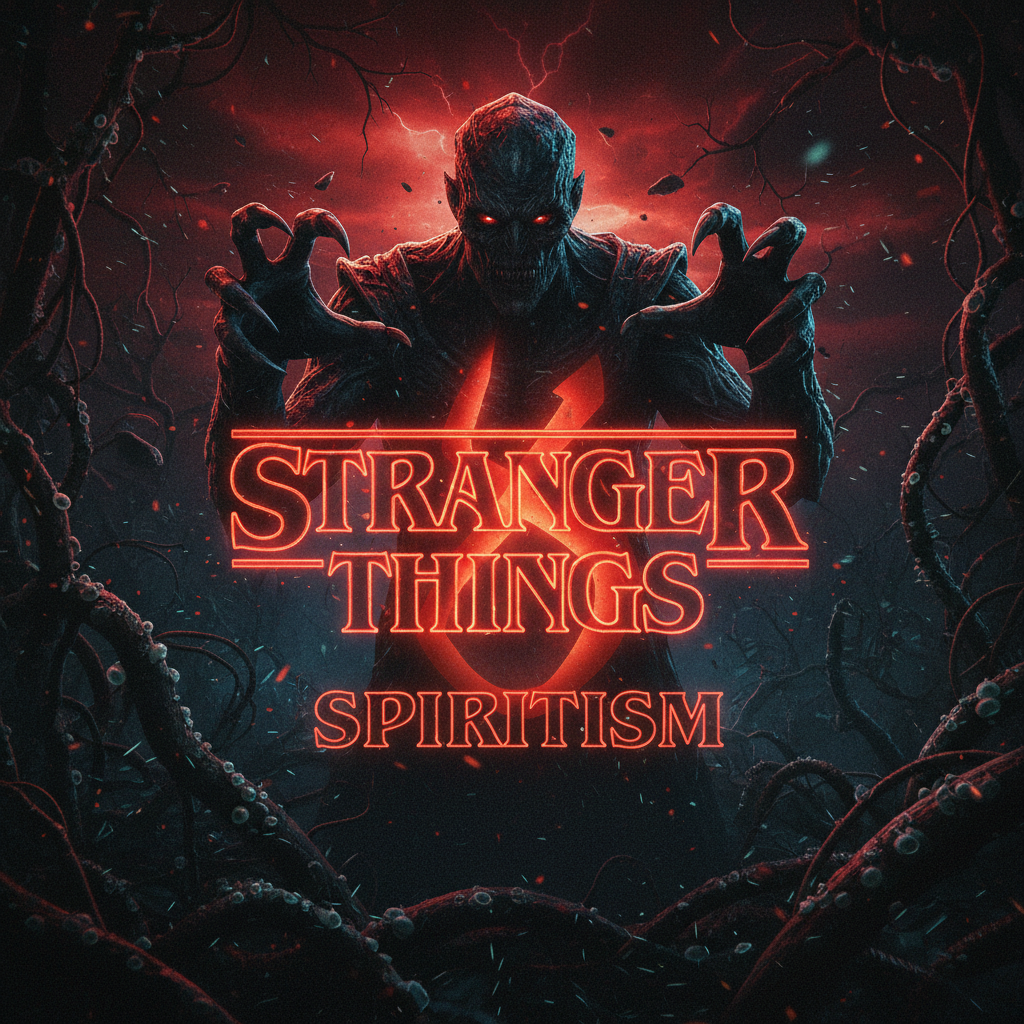
If you watched season four of Stranger Things, you were probably struck by the villain Vecna and his “psychic” way of connecting to victims. What the show presents in fictional language has an interesting point of contact with a concept dear to Spiritism: the attunement of thought. Without confusing entertainment with doctrine, we can use the series’ popularity to reflect—lightly and respectfully—on how thoughts and vibrations draw us closer to spiritual companions with similar tendencies, fostering uplifting experiences or, on the contrary, heavier psychic environments.
In this article, we’ll explore:
- What Stranger Things suggests about “mental connections”
- What Spiritism teaches about thought, affinity, and spiritual influence
- A possible analogy between Vecna and obsessive processes (without sensationalism)
- Simple daily practices for mental and spiritual hygiene
- Boundaries and care: mental health, religious freedom, and common sense
Important note: Stranger Things is a work of fiction with a dramatic horror aesthetic. Spiritism is a philosophy with moral consequences that seeks to console and clarify. Our goal here is educational and reflective, respecting all beliefs without promoting fear.
Vecna’s “mental radar” in fiction
In the show, Vecna “anchors” himself in psychological fragilities and traumas, locating his victims and then invading their minds. The narrative blends telepathy, mental suggestion, and a kind of “field” that tunes the villain to denser emotions. Naturally, it’s all wrapped in horror elements: visions, hallucinations, and fantastical effects.
With all due proportion, there’s a concept recognizable to those who study mediumship: minds tune by affinity. In everyday terms, “what vibrates alike, connects.” In the series, the drama is painted in bold strokes. In life, things are subtler, but the law of affinity still applies.
What Spiritism says about thought and attunement
Spiritist teachings—especially in Allan Kardec’s The Spirits’ Book and The Mediums’ Book—explain that:
- Thought is force, vibration, and creation. It shapes environments, inspires actions, and establishes bridges between consciousnesses.
- Attunement occurs through moral and vibrational affinity. Thoughts, feelings, and habits create psychic “addresses.”
- Spirits influence our lives more than we imagine—positively or negatively—but they do not cancel our free will.
- Mediumship is not synonymous with fragility. It’s a natural faculty that can be educated for good through discipline, study, and moral improvement.
So when we speak of “thought attunement,” it isn’t superstition: it’s the idea that each of us radiates a mental “tone.” That tone attracts compatible spiritual company. Higher attunements (charity, gratitude, serenity) resonate with benefactors. Lower attunements (hatred, resentment, addictions) feed disturbing influences.
The bridge to Stranger Things: a useful (and limited) analogy
- In fiction: Vecna “sniffs out” dense emotions, dives into guilt and trauma, exploits vulnerabilities, and “pulls” his victims into a mental field dominated by him.
- In Spiritist understanding: obsessive processes involve minds in disharmony that couple by affinity. There are no “monsters from another dimension,” but there are brothers and sisters in suffering who, through vengeance, ignorance, or imbalance, attempt to influence and vampirize energies.
The analogy, then, is this: the more we cultivate inferior thoughts and habits, the more our “frequency” becomes likely to tune with similar influences. However, there are essential differences:
- There is no fatalism: free will and spiritual support are real.
- Help is always accessible through prayer, inner reform, doing good, and fraternal support.
- Obsessive processes are approached with charity toward everyone involved—incarnate and discarnate.
Why does music “save” in Stranger Things? The role of elevation
One of the most memorable moments of season four is when a beloved song becomes salvific for a character, opening an “escape route” from Vecna’s influence. Symbolically, this connects to what Spiritism recommends as a real tool for vibrational elevation:
- Art that inspires the true, the good, and the beautiful
- Sincere prayer
- The Gospel at Home practice
- Gratitude and charity as habits
- Inner reform in doable steps
Uplifting music, noble reading, and prayer genuinely raise our mental pattern. It’s not magic; it’s attunement. By nourishing higher emotions, we change the station.
Mediumship isn’t a “radar for evil”: it’s a faculty in service of good
The series might lead some to think that “sensitives” are more vulnerable to dark forces. In Spiritism, mediumship:
- Is a neutral faculty, present in varying degrees in everyone
- Gains safety through study, discipline, service to others, and a principled life
- Shouldn’t be a stage for showmanship or a source of fear
- When developed with guidance in a serious Spiritist center, becomes an instrument of comfort and enlightenment
In short, light doesn’t fear shadow—it illuminates it. Well-guided mediums don’t “attract Vecnas”; they become collaborators in spiritual assistance.
Mental and spiritual hygiene in daily life
To avoid “giving an address” to lower influences, Spiritist tradition suggests simple, consistent practices:
- Daily prayer: brief, spontaneous, and sincere—on waking and before sleep
- The Gospel at Home: once a week, brief reading, reflection, and prayer with the family, respecting everyone’s beliefs
- Content discipline: choose what we watch, listen to, and say; avoid sources that stoke hatred and despair
- Good music and uplifting art: soundtracks that elevate, readings that inspire, films that offer solace
- Service to others: charity is powerful “vibrational cleansing” because it shifts the focus from me to us
- Emotional self-education: therapy when needed, plus healthy habits (sleep, nutrition, exercise)
- Harmonized environments: cleanliness, organization, kind words, and—if it fits your faith—a short prayer as you start your tasks
- Practical gratitude: list three reasons to be thankful every day; simple and powerful
Spiritual obsession vs. mental health: a necessary dialogue
It’s crucial to differentiate:
- Psychological suffering that requires clinical care (psychologists, psychiatrists)—Spiritism encourages seeking professional help
- Spiritual influences that call for thought education, prayer, passes, and fraternal support
Often, the two areas intertwine. The safest path is integrated care: medical treatment when indicated, allied with responsible spiritual practice. Don’t substitute one for the other.
Myths and truths about thought attunement
- “Negative thinking automatically attracts disaster.” Myth. Thoughts influence our disposition and environment, but there’s no magical determinism. There are tendencies of affinity.
- “I am a victim of invisible forces with no way out.” Myth. Spiritual aid is always available. Prayer, charity, inner reform, and fraternal support change the station.
- “Mediumship leaves me ‘open’ to evil.” Myth. Disciplined, supported mediums become channels for good.
- “Thought is a real force.” Truth. It shapes our attitude, impacts relationships, and creates a psychic climate.
- “Music can raise vibration.” Truth. Art and beauty refine the mental and emotional field.
How to strengthen your attunement today
If the idea of thought attunement resonates with you, try this simple 7-day plan:
Day 1: Ten minutes of silence and a short, sincere prayer. Choose an inspiring song and listen attentively.
Day 2: Do a small anonymous kindness. Notice the lightness it brings.
Day 3: Organize a corner of your home with care. Outer order helps clear the mind.
Day 4: Read a passage from The Gospel According to Spiritism (or a text from your tradition of faith) and discuss it with family.
Day 5: Take a walk outdoors, breathe deeply, and give thanks for three simple things from the day.
Day 6: Reduce consumption of news and content that weigh you down. Swap them for an inspiring film.
Day 7: Hold the Gospel at Home (if that’s your choice), with a brief reading, reflection, and prayer.
At the end, observe: How is your mood? Your sleep? Your conversations at home? Small changes, big effects.
And when “the mind won’t help”?
There are hard days. Trauma, grief, and anxiety are real. The higher spirituality understands our limitations. If your mind pulls you downward:
- Seek professional help. Caring for mental health is an act of courage.
- Visit a serious Spiritist center for fraternal conversation, passes, and study.
- Don’t demand that you “vibrate high” all the time. Loving persistence matters more than perfection.
The goal isn’t to never feel pain; it’s to learn to handle it more consciously, compassionately, and connected to good.
Stranger Things as metaphor: from fear to awareness
Stranger Things uses horror to talk about human themes: guilt, friendship, loss, and courage. Stripped of the cinematic supernatural noise, the lesson remains: strong relationships, sincere affection, and a sense of purpose are powerful antidotes to our inner “Vecnas”—the fears and guilts that try to imprison us.
Through the Spiritist lens, transforming thought attunement means shifting consciousness toward more luminous fields, through daily choices that bring us closer to good. That doesn’t require special effects; it asks for consistency, kindness, and active faith.
Conclusion: tune into good, tune into help
Vecna’s “location” of victims, seen through the lens of fiction, points to a spiritual truth: affinity matters. Thoughts are connections. If we want elevated company, let’s cultivate what is elevated: sincere prayer, work in service, gratitude, study, and inspiring art.
Let the series remind us of a consoling reality: we are never alone. Wherever there is a heart in prayer and hands ready to serve, there is response, support, and safety. Change the station, change the story.
—
Want to go deeper? Look for a trustworthy Spiritist center in your area for systematic study and fraternal dialogue. And if this content did you good, share it with someone who might benefit.
Count on mediunidades.com for new topics that connect pop culture and Spiritism—always with lightness, respect, and fidelity to Spiritist principles.